2026-09-20
Key Points for Successful Revision Rhinoplasty: Real Patient Reviews of Autologous Rib Cartilage
Explore why autologous rib cartilage is vital for successful revision rhinoplasty, featuring real patient cases, structural benefits, and expert tips from Want Plastic Surgery.

Hello, this is Want Plastic Surgery.

For those considering revision rhinoplasty,
we would like to explain in detail about
autologous rib cartilage rhinoplasty,
which is one of the most frequently asked topics.
If you have had a prior nose surgery
and are unsatisfied with the results,
pay close attention!
Why Is Revision Rhinoplasty More Difficult?
When deciding on nose surgery,
many people first worry about which graft material to use.
What are the typical challenges of revision rhinoplasty?
☑️ Structural collapse caused by forcefully stretching inelastic skin
☑️ Asymmetry caused by a deviated or bent nasal tip
☑️ Complications such as a drooping or descending nasal tip
These issues ultimately stem from material selection.
They occur when a surgeon forces a weak material to support the nose,
or attempts correction that the graft
simply cannot structurally withstand.
Key Characteristics of Revision Rhinoplasty and Why Autologous Rib Cartilage Is Needed!
Compared to primary nose surgery,
revision rhinoplasty deals with skin that does not stretch as easily.
This is because scar tissue has formed from the initial operation,
and the nose structure has already been elevated once.
Under these conditions, a much stronger framework
is required to support the nose.
If the central pillar is not robust enough,
the risk of structural collapse under inelastic skin increases significantly.
Therefore, to achieve the desired aesthetic contour
without compromising or damaging the skin envelope,
using a sufficiently strong material is essential.
The best choice in this scenario is autologous rib (costal) cartilage.
Common options include autologous rib, donated (cadaveric) cartilage, and septal cartilage.
Among these, autologous rib cartilage boasts the greatest structural strength.
Therefore, when undergoing revision rhinoplasty,
using your own rib cartilage provides the greatest advantage.
Two Core Benefits of Autologous Rib Rhinoplasty!
Unmatched Structural Strength
Among autologous rib, donor cartilage, and septal cartilage,
autologous rib cartilage is the firmest and most durable.
It is the most suitable material for establishing a sturdy columellar strut
in the fragile structural environment of a revision surgery.
Abundant Material Volume
Another crucial factor in revision rhinoplasty
is the volume of harvestable material.
If material is insufficient, achieving an optimal surgical outcome is difficult.
Autologous rib cartilage has the distinct advantage
of yielding a generous supply in a single harvest,
allowing surgeons to construct the strongest support
without worrying about running out of graft material.
This significantly increases the likelihood of achieving the ideal aesthetic result.
Real Patient Cases of Autologous Rib Rhinoplasty
Case 1: Correcting an Upturned Nose + Desiring a Defined, High Nasal Tip
This patient presented with a slightly upturned tip
and desired a more glamorous, refined nasal contour.
De-rotating and lengthening an upturned nose
is widely considered one of the most challenging rhinoplasty maneuvers,
as bringing the tip downward
requires an exceptionally strong supporting pillar.
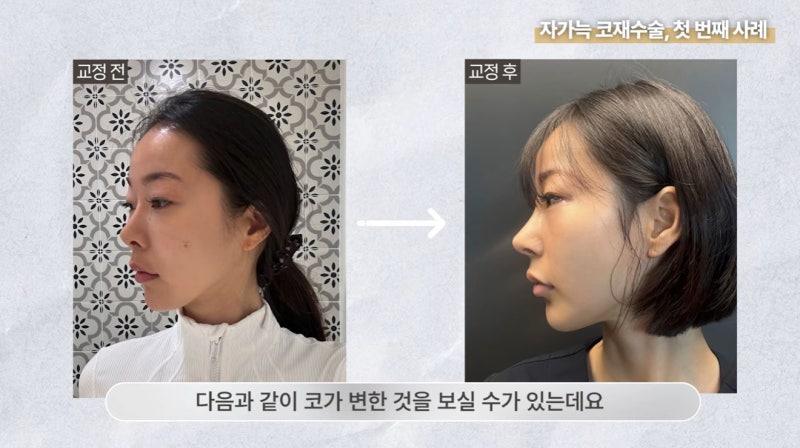
In this case, autologous rib cartilage was recommended.
After lowering the nasal tip along with the nostril rims,
the bridge and tip were completely reconstructed
using autologous rib cartilage combined with a customized silicone implant.
In revision cases, relying solely on remaining septal or ear cartilage
often fails to resist downward skin tension,
frequently leading to deviation or tip collapse.
Building a sufficiently strong framework with autologous rib
offers a clear clinical advantage.
Case 2: Low-Appearing Tip and Exposed Nostrils Due to Mouth Protrusion
This patient had slight bimaxillary protrusion,
which made the nasal tip appear flatter
and caused the nostrils to look excessively flared and upturned.

Correcting an upturned look in this structural setting
demands a robust supporting strut,
so autologous rib cartilage was again recommended.
Post-operatively, the nasal tip was projected forward adequately,
resolving the upturned appearance
and achieving a sleek, balanced tip contour.
The bridge line was smoothly harmonized
using a custom-fitted silicone implant.
Are There Any Disadvantages to Autologous Rib Cartilage?
Of course, autologous rib cartilage is not without potential drawbacks:
☑️ A small scar at the donor chest site
☑️ Discomfort or soreness in the donor area during early recovery
☑️ Natural tendency of rib cartilage to warp if not handled properly
However, when these factors are managed properly
by a surgeon with proven surgical experience and technique,
autologous rib cartilage remains the most dependable
and resilient material for complex revision rhinoplasty.
Revision rhinoplasty is inherently more demanding than primary surgery
and necessitates a sturdier, more durable structural foundation.
For this reason, it is critical to consult a clinic
with extensive rhinoplasty expertise and refined mastery
over autologous rib cartilage techniques.
If you are considering primary rhinoplasty, revision surgery, or complex nasal reconstruction, we strongly advise a comprehensive consultation focusing on material selection first.
Why autologous rib cartilage is preferred for revision rhinoplasty,
the root causes of rhinoplasty failure, and structural reconstruction!
https://www.youtube.com/watch?v=YC8C2kUab8Y
If you would like to schedule an in-depth consultation,
please feel free to reach out to us at any time.
[KakaoTalk Channel Consultation]

Want Plastic Surgery Clinic
Your Want is Our Want.
pf.kakao.com
[Naver Booking]
https://m.booking.naver.com/booking/13/bizes/1450109?theme=place&lang=ko&area=ple
[Official Instagram]
https://www.instagram.com/wantprs_kr

Frequently Asked Questions
Why is autologous rib cartilage recommended for revision rhinoplasty?
Autologous rib cartilage provides superior structural rigidity and is available in generous volume. Because revision cases often involve scarred, inelastic skin requiring robust internal support, rib cartilage prevents structural collapse, warping, and tip drooping better than septal or donor cartilage.
What are the potential drawbacks or side effects of using autologous rib cartilage?
Potential disadvantages include a small scar and temporary soreness at the donor site, as well as the intrinsic risk of cartilage warping. These issues can be effectively managed and minimized by choosing a skilled, experienced surgeon well-versed in rib cartilage harvesting and carving techniques.
Is autologous rib cartilage suitable for correcting an upturned or short nose?
Yes, autologous rib cartilage is particularly well-suited for lengthening short, contracted, or upturned noses. De-rotating the nasal tip downward requires strong, resilient structural support to counteract skin tension, which rib cartilage reliably provides.
Why is graft harvest volume so important in revision rhinoplasty?
Securing sufficient harvest volume allows the surgeon to build a stable, complete framework without compromise. When graft material is scarce, achieving the desired projection and shape becomes difficult; autologous rib cartilage ensures an ample supply for comprehensive reconstruction.