2026-09-19
Revision Rhinoplasty: Why Choosing Autologous Costal (Rib) Cartilage Matters!
Explore why autologous rib cartilage is vital in revision rhinoplasty for correcting contracture, implant issues, and drooping tips with superior structural support.
Hello, this is WANT Plastic Surgery.

As time passes following a primary rhinoplasty,
many people consider revision surgery due to various concerns,
such as an upturned nasal tip, a deviated bridge,
or visible implants under thinning skin.
When contemplating revision rhinoplasty,
one of the most widely discussed approaches
is reconstruction using autologous costal (rib) cartilage.
Let’s explore in detail why rib cartilage
is considered a crucial graft material in revision rhinoplasty
and which cases benefit most from it!
Can you achieve your desired nasal profile, even on the second try?
Due to complications like scar tissue, adhesions, and limited remaining cartilage,
revision rhinoplasty is undeniably more complex and demanding than primary surgery.
The key is to accurately identify
why the previous rhinoplasty failed to deliver satisfactory results.
Only after a thorough evaluation of the implant status,
the degree of cartilage resorption, and the extent of internal adhesions
can a surgeon determine how much of the aesthetic design can be realistically achieved.
This is why, even for similar revision cases,
outcomes vary dramatically depending on the depth of diagnosis
and the surgeon's clinical expertise.
When Is Autologous Costal (Rib) Cartilage Needed in Revision Rhinoplasty?
During revision surgery, it is quite common to find
that previously harvested septal or ear cartilage is damaged
and cannot be safely reused.
In such situations, cartilage must be harvested
from another donor site on the patient's body—
typically ear cartilage, septal cartilage, or costal (rib) cartilage.
Autologous rib cartilage is strongly considered
in the following scenarios:
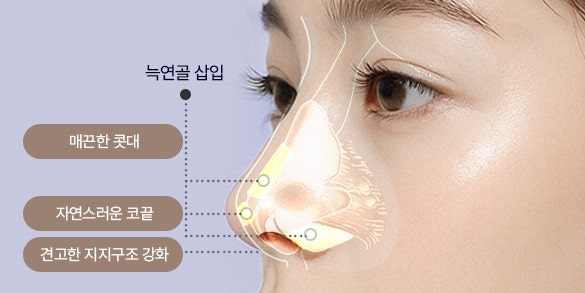
✅ When the septal cartilage is weak, damaged, or insufficient to serve as a structural graft
✅ When remaining donor cartilage is insufficient to achieve the desired structural profile
✅ When revision is required due to complications associated with silicone implants
✅ When a patient prefers a completely autologous rhinoplasty without artificial foreign materials
✅ When severe capsular contracture or inflammation demands reconstructive-level revision
✅ When severe septal deviation requires simultaneous functional airway improvement
Due to its high structural rigidity, rib cartilage is an ideal material
for creating a robust framework for the nasal tip during revision.
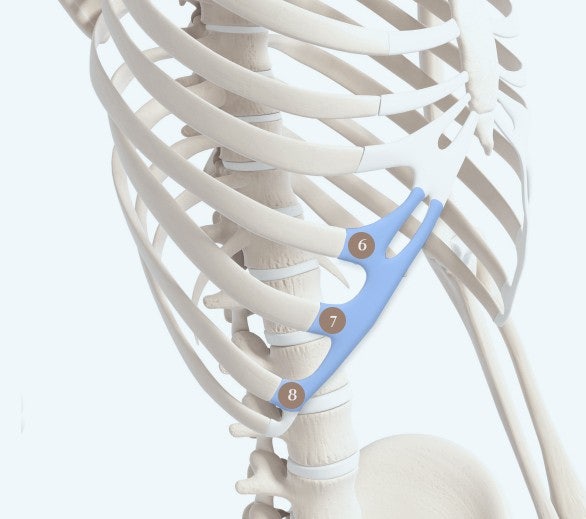
Typically, a small section from the right 6th to 8th rib cartilage
is harvested for rhinoplasty.
Because it is the patient's own tissue, it carries a relatively low risk
of infection or rejection, has minimal resorption rates,
and maintains long-term structural stability
without deformation over time.
However, costal cartilage has an inherent natural curvature,
which can rarely lead to "warping"—a tendency to bend
back toward its original shape over time.
What Is Warping?Because curved costal cartilage inherently retains internal tension,it may rarely twist or deviate over time as it attempts to returnto its original curved shape.
Therefore, having an experienced surgeon
who employs advanced carving techniques
and precise fixation methods to prevent warping
is a critical factor for achieving long-lasting stability.
Applications of Autologous Rib Cartilage by Revision Type
Because post-rhinoplasty deformities vary widely from person to person,
a customized, case-specific approach is essential.


Drooping Nasal Tip (Tip Ptosis)
When a weakened cartilage framework causes
the columella to retract and the tip to droop,
autologous rib cartilage can be used to extend the columella
and build a sturdy strut, allowing precise correction of the nasolabial angle.
Upturned Nasal Tip (Contracted / Short Nose)
When the tip becomes upturned or shortened due to severe scarring or capsular contracture,
rib cartilage revision reconstructs a strong structural framework
to restore natural length and balance in proportion to the face.
Unsatisfactory Profile / Shape
If the patient is dissatisfied with aesthetic aspects—such as an asymmetric bridge,
an overly low dorsum, or an excessively long nose—
a tailored revision is performed to re-establish balanced contours matched to facial proportions.
Pinched Nasal Tip
When excessive suture tension or alar collapse causes
the cartilage to become visibly pinched or deformed,
revision surgery focuses on targeted cartilage restructuring to restore natural contour and volume.
Checkpoints to Increase Your Revision Rhinoplasty Success Rate
If you are planning a revision rhinoplasty,
we recommend verifying the following points beforehand:
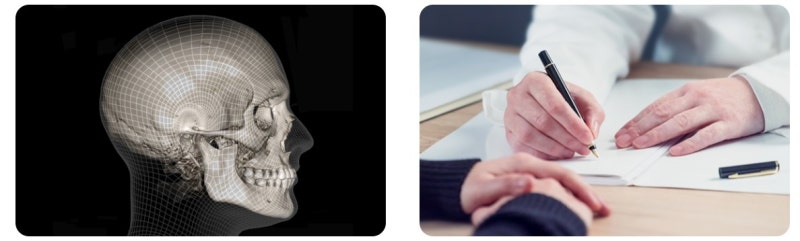
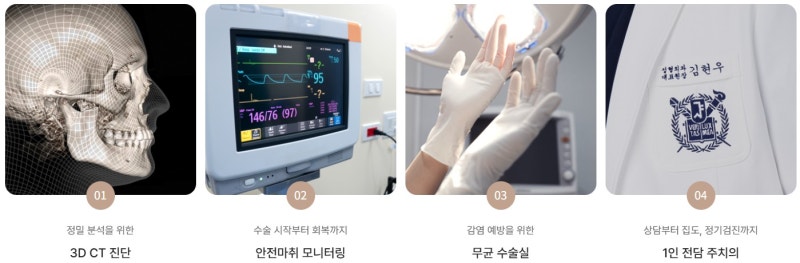
☑️ Does the clinic conduct precise 3D-CT diagnostics to analyze the nasal septum, harvestable cartilage, bone structure, and internal scar adhesions?
☑️ Does the surgeon offer a customized material choice suited to your condition, whether autologous rib, septal, or ear cartilage?
☑️ Does the surgical technique involve minimal incision harvesting with dedicated scar care protocols?
☑️ Does the surgical plan address functional breathing restoration alongside aesthetic contouring?
☑️ Does a single dedicated surgeon handle the entire journey—from consultation and surgery to post-operative follow-up?
Because recovery from revision rhinoplasty
can vary significantly among individuals,
diligent post-operative care—such as avoiding smoking, alcohol, and external pressure,
along with attending scheduled progress checks—is essential.
Autologous Rib Cartilage Revision Is Recommended For:

✅ Those with implants that appear unnatural, shifted, or visible through thinning skin
✅ Those whose nasal implant has deviated, shifted, or become unstable
✅ Those experiencing an overly sharp tip due to skin thinning
✅ Those with a shortened, upturned nose caused by contracture
✅ Those who have developed inflammation or infection following previous surgery
✅ Those who have undergone multiple revisions without achieving satisfactory results
We invite you to consult with Dr. Hyun-Woo Kim at WANT Plastic Surgery,
where precise 3D-CT diagnostic planning,
advanced anti-warping carving techniques,
and comprehensive aftercare come together.

Because the decisions you make for both primary and revision rhinoplasty
have lasting impacts,
a thorough and careful approach is crucial.
If you would like to schedule a consultation,
feel free to reach out anytime!
[KakaoTalk Plus Friend Consultation]

WANT Plastic Surgery Clinic
Your Want is Our Want.
pf.kakao.com
[Naver Booking]
https://m.booking.naver.com/booking/13/bizes/1450109?theme=place&lang=ko&area=ple

[Official Instagram]
https://www.instagram.com/wantprs_kr

Frequently Asked Questions
When is autologous costal (rib) cartilage necessary in revision rhinoplasty?
It is required when previously harvested septal cartilage is damaged or when remaining donor tissue is insufficient. It is also strongly recommended for severe contracture, recurrent inflammation, silicone implant complications, or when a patient prefers a completely autologous graft without synthetic implants.
What are the main advantages of using autologous rib cartilage?
Rib cartilage provides exceptional structural strength, making it ideal for creating a stable support frame for the nasal tip. Harvested from the patient's own 6th to 8th rib, it has minimal resorption rates and significantly reduces the risks of foreign-body reaction or infection, ensuring long-term shape retention.
What is the warping phenomenon associated with rib cartilage rhinoplasty?
Warping refers to the natural tendency of curved cartilage to twist or bend toward its original curvature over time. Because it can cause structural deviation, it is essential that the revision is performed by a surgeon skilled in anti-warping carving and specialized fixation techniques.
Can a severely contracted, upturned nasal tip be corrected with rib cartilage?
Yes. Autologous rib cartilage provides the structural strength needed to lengthen and reconstruct a severely shortened or contracted nose, effectively restoring balanced nasal proportions and a natural profile.
What should I check before undergoing revision rhinoplasty?
Ensure that the clinic utilizes 3D-CT imaging to evaluate internal cartilage, nasal bones, and scar tissue. Confirm that the surgeon has extensive experience in both aesthetic refinement and airway preservation, and that the same specialist oversees your entire surgical process from diagnosis to post-operative recovery.